Open-plan homes have transformed the way we think about interiors. A living room may flow directly into the dining area, which opens onto a kitchen, while a hallway or family room continues the visual conversation. The lack of walls creates a wonderful sense of space, but it also introduces a decorating challenge: how do you give each area its own character without making the entire floor plan feel disjointed?
Window treatments are a big part of the answer.
When several windows are visible from the same space, choosing identical curtains or shades for every opening can feel predictable. On the other hand, giving every window a completely different treatment can make an open-plan interior look chaotic. The most sophisticated approach sits somewhere between the two. Designers often create a sense of cohesion through shared colors, complementary fabrics, consistent hardware, and similar proportions while allowing individual spaces to have their own personalities.
The result is a home that feels connected without looking overly coordinated.
Start With the Architecture, Not the Fabric
Before choosing fabrics, look at the architecture of the entire open-plan space. Identify which windows are visible from one another, which openings have similar proportions, and where the major architectural transitions occur.
A bank of windows running from the living room into the dining area may benefit from treatments that feel closely related, while a smaller kitchen window can have a different treatment altogether. The objective is not to make every window identical, but to make the treatments feel as though they belong to the same design scheme.
It also helps to consider the position of the furniture. A large expanse of curtains behind a sofa will have a different visual impact from a small roman shade above a kitchen counter. The treatments should respond to the scale and function of each area rather than being selected independently.
Once you understand the architecture, it becomes much easier to decide where you can introduce variation.
Establish a Common Color Palette
The simplest way to connect different window treatments is through color. They do not need to be the same color, but they should relate to one another and to the wider interior.
For example, you might use warm ivory curtains in the living room, a soft taupe roman shade in the kitchen, and patterned curtains incorporating both colors in the dining area. The treatments are visibly different, yet the repeated tones create a subtle thread that travels through the open space.
Gray can be particularly useful when you want a neutral color that bridges different areas. Gray window roman shades can sit comfortably alongside warm wood, cream upholstery, black accents, or cooler blue and green tones, depending on their undertone. A pale warm gray might connect a beige living room to a cooler kitchen, while a deeper charcoal can provide definition around a large window.
The important thing is to repeat colors thoughtfully rather than matching everything exactly.
Give Each Zone Its Own Personality
An open-plan home still benefits from distinct visual zones. The living room may be relaxed and layered, the dining area more formal, and the kitchen clean and practical. Window treatments can reinforce those differences without breaking the overall flow.
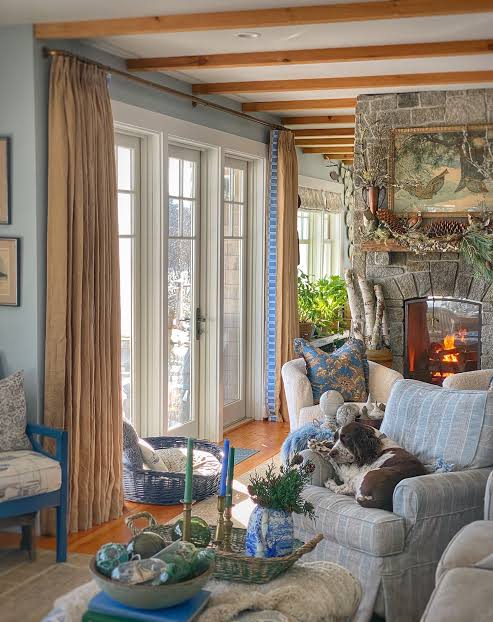
A living room might call for full-length custom curtains that soften the architecture and create a sense of warmth. In the kitchen, a tailored roman shade may be more practical, particularly where floor-length fabric would interfere with cabinetry or work surfaces. The dining area could then introduce a patterned fabric that echoes the living room palette while giving the space a little more personality.
This variation makes the home feel designed rather than repetitive. The trick is to make sure the differences are intentional and connected to the function of each zone.
Coordinate Without Matching
One of the easiest mistakes in an open-plan home is assuming that every visible window should use the same fabric.
Matching can certainly create cohesion, but it is not the only way to achieve it. In fact, using exactly the same treatment everywhere can flatten the distinction between different areas and make the design feel overly prescribed.
Instead, think in terms of coordination. Perhaps the living room has plain linen curtains, while the dining area uses a patterned version of a similar neutral and the kitchen has a solid roman shade in one of the pattern’s secondary colors.
The fabrics are not identical, but they clearly belong together.
This approach becomes particularly effective when working with custom roman shades and custom curtains, because you can select each treatment according to the individual window while maintaining a consistent overall palette.
Use Pattern Strategically
Pattern is one of the best ways to give individual areas personality, but it should be introduced with some restraint when the rooms are visually connected.
If the living room already has a large-scale patterned rug and expressive artwork, you may want to keep its window treatments relatively quiet. The dining area, by contrast, might be the perfect place to introduce a botanical or geometric curtain.
Patterned curtains can work especially well in an open-plan dining space because they establish a focal point without requiring another major piece of furniture or artwork. If the pattern includes colors already found elsewhere, it can actually help unify the entire floor plan.
When mixing multiple patterns across an open space, vary their scale. A large botanical on the curtains should not necessarily be paired with another large-scale pattern on a nearby shade. Smaller checks, subtle stripes, or tonal motifs can provide interest without competing for attention.
Use Texture to Create Cohesion
Color and pattern are not the only ways to connect different treatments. Texture can be even more subtle.
Imagine a living room with relaxed linen curtains, a kitchen with a woven roman shade, and a dining area with softly textured drapery. The colors may differ slightly, but the shared natural quality of the fabrics creates a visual relationship.
Texture is especially valuable in neutral interiors because it adds depth without introducing additional colors. Linen, velvet, cotton, woven fabrics, and slubby textiles each reflect light differently, giving the windows dimension throughout the day.
If one area already has a bold pattern, using texture rather than another print in the adjacent space can create a much more balanced result.
Consider Sheer Treatments for Large Openings
Large open-plan windows can be beautiful, but they can also become visually heavy when covered with substantial layers of fabric. This is where sheers can play an important role.
Sheer roman shades can filter sunlight while preserving the airy quality of an open space. They are particularly effective in areas where you want privacy during the day without completely blocking natural light.
Sheers can also be layered with heavier curtains in a living or dining area. The lighter layer provides daytime softness, while the curtains can be closed when more privacy or light control is needed.
Using a sheer treatment in one area and a heavier treatment in another does not have to look inconsistent. As long as the fabrics and colors relate to the wider scheme, the difference can actually emphasize the function of each zone.
Repeat Hardware for a More Unified Look
If the fabrics are different, consistent hardware can help tie everything together.
Using the same or complementary finishes for curtain rods, rings, brackets, and other visible hardware creates a subtle architectural rhythm across the space. This is particularly effective when the windows are all visible at once.
For example, black hardware can provide continuity between a room with patterned curtains and another with simple roman shades. Brass can introduce warmth across a home filled with cream, taupe, and natural wood.
The hardware does not need to be identical in every location, but maintaining a common finish or design language can make different treatments feel intentionally related.
Keep Mounting Heights Consistent Where Possible
Even when the treatments themselves differ, consistent installation can make an enormous difference.
If one set of curtains is mounted close to the ceiling while another is installed directly above the window frame, the eye may register the difference as accidental rather than intentional. Where the architecture allows, try to establish a consistent visual height for curtain rods and other treatments.
Mounting curtains higher can also make ceilings appear taller, which is particularly useful in open-plan homes where maintaining a sense of vertical continuity is important.
Roman shades naturally sit closer to the window, so they will have a different profile. That is perfectly acceptable. The goal is not identical placement but a deliberate relationship between the treatments.
Think About the View From Every Angle
Open-plan rooms are experienced from multiple directions, so consider what each window treatment looks like from across the space.
A patterned curtain that looks wonderful from close up may become visually dominant when seen from the kitchen. A dark shade might appear balanced in the living room but create a heavy block of color when viewed from the dining area.
Walk through the room and look at the windows from different positions. Consider how the fabrics interact when several treatments are visible simultaneously.
This is one of the advantages of designing an open-plan home as a whole rather than decorating each zone independently.
Use Custom Treatments to Solve Awkward Windows
Open-plan homes often contain windows of different sizes and shapes, particularly in older houses that have been remodeled or extended. Standard window treatments may not provide the consistency you need when the architecture itself is inconsistent.
Customization allows each treatment to respond to the individual window while maintaining a common design language.
Custom drapes can be tailored to the exact height and width of large openings, while roman shades can be made to suit smaller or unusually proportioned windows. In a more traditional open-plan home, custom window valances can also introduce a decorative element without requiring full-length curtains in every space.
The benefit is not simply better fit. It is the ability to make different windows feel as though they were considered together from the beginning.
Let the Function of Each Space Guide You
An open-plan home may have a unified visual language, but each zone still has practical requirements.
A kitchen window may need a treatment that is easy to operate and maintain. A bedroom or adjacent sleeping area may require greater privacy and light control. A living room may prioritize softness and visual impact, while a dining area might benefit from a more decorative treatment.
Do not sacrifice function simply to make every window look consistent.
Instead, find treatments that perform differently while sharing a common aesthetic. A roman shade can provide practical coverage in one zone, while curtains offer flexibility and softness in another.
When the function determines the treatment, the design tends to feel more natural.
Create a Visual Rhythm
The most successful open-plan interiors have a rhythm that guides the eye from one area to another.
Window treatments can contribute to this rhythm through repeated colors, fabrics, hardware finishes, or silhouettes. You might have curtains in the living room and dining room, with a roman shade in between. Or you might repeat a particular neutral across several different treatments.
The repetition should be subtle enough that you notice the relationship rather than the formula.
Think of it as creating a visual conversation. One window treatment introduces an idea, another picks it up, and a third interprets it slightly differently.
That is what makes a large, open space feel layered rather than monotonous.
The Goal Is Cohesion, Not Uniformity
Mixing window treatments throughout an open-plan home becomes much easier when you stop trying to make everything match. The strongest interiors usually have a consistent foundation with enough variation to keep each space interesting.
Start with a shared color palette, then introduce different fabrics according to the function and character of each zone. Use pattern selectively, rely on texture when you need subtle variation, and repeat hardware or other details to maintain continuity.
Most importantly, look at the home as one connected composition.
The living room, dining area, and kitchen may have different furniture and different functions, but the windows should still feel as though they belong to the same story.
That might mean custom curtains in one area, custom roman shades in another, and a more decorative treatment somewhere else entirely. The magic lies in the relationships between them.
An open-plan home does not need identical windows to feel cohesive. It needs a thoughtful visual language that allows every window to speak in its own voice while still being part of the same conversation.